Chris Wristen

Stories from a writer on the run

  • About
  • Races
  • Writing portfolio

A ROYALS RETROSPECTIVE: 1985 TO 2014

Posted by Chris Wristen on September 27, 2014
Posted in: Uncategorized. Leave a comment

It felt surreal to wake up this morning knowing that, for the first time since I was 5 years old, the Kansas City Royals are a playoff baseball team. It wasn’t a dream. No pinching necessary; it’s absolutely legit. The Royals are going to the playoffs.

This morning's Kansas City Star front page after the Royals earned their first playoff berth in 29 years.

This morning’s Kansas City Star front page after the Royals earned their first playoff berth in 29 years.

Twenty-nine years. Man, that’s been almost an entire lifetime. People throughout Kansas City – and Kansas City natives around the world – are partying like 1985! That was such an incredible season. Back to the Future was on the big screen; “Careless Whisper” by Wham was the No. 1 song on the charts (although, fittingly, Don Henley’s “Boys of Summer” and Bruce Springsteen’s “Glory Days” also were among the top hits); the original Nintendo was so new that you didn’t yet need to blow into the games to make them work; and, of course, George, Frank, Sabes and the boys in blue were celebrating a World Series championship here in Kansas City.

I remember it so vividly, like it was yesterday … I think.

I do remember it, don’t I?

I mean, there was Don Denkinger’s blown call on Jorge Orta’s infield single that propelled the Royals to victory in Game 6 against St. Louis.

There was the fly ball to Daryl Motley for the final out of Game 7, followed by Bret Saberhagen leaping into George Brett’s arms and, of course, the ensuing dogpile.

The memories are all so vivid, so very real … aren’t they?

I’ve thought about it more and more during the past few weeks as the Royals have closed in on the long-elusive playoff berth to end what was by far the longest postseason drought in major American sports. The more my mind chewed on it, the more I simply wasn’t sure.

Do I really remember the 1985 World Series? Or have the highlights simply been seared into my mind after being played so many times through the years since, let’s face it, there have been so few Royals highlights worth showing.

That’s not to say the Royals have been flat-out awful continuously during the playoff drought. Truth be told, they were plenty good for most of a decade after winning the World Series. They posted winning records in six of the next nine seasons, including winning 92 games in 1989. The 1987 squad finished two games out of first in the division, and the 1994 squad was four games out of first when the MLB strike canceled the season.

After the strike, however, the Royals finished with losing records in 17 of the next 18 seasons, including four 100-loss seasons in a five-year span. In fact, the one winning season — 2003 — was so unexpected that it was considered “magical” because the team finished four whole games above .500, or — as the rest of the league calls it — slightly above average.

The Royals’ Hall-of-Famers were long gone during that time; the franchise was devoid of superstars who wanted to stay; and the franchise looked every bit what you’d expect from a team owned by a former Wal-Mart executive.

As a fan base, Kansas Citians grew accustomed to the memories of 1985. We’d see the highlights a few times each year, reminding us of the good times and the reasons we remained loyal to the franchise all these years. It reminded us of the passion and fury that George Brett brought to the ballpark each day, of the speed and grace with which Willie Wilson patrolled the outfield, and the perfection displayed by Frank White at second base.

The throwback highlights also allowed us to forget – at least temporarily – the putrid level of stink that the Royals had come to embody in the years since David Glass took over the franchise following longtime owner Ewing Kauffman’s death.

The 1985 Royals and early 1990s Royals were Mr. Kauffman’s Royals. They were fighters, a blue-collar bunch of gritty guys who embodied the spirit of the city.

This was Mr. Glass’s Royals. And this. And this. And this. Clowns. Jokers. Buffoons. Give them this much credit: they were awfully clever at inventing ways to lose. I mean … seagulls. Yes, that’s correct. Seagulls.

It’s been a pretty miserable 29-year drought for Royals fans with a generation growing up knowing their franchise as a 162-game-per-year blooper reel and with most, like myself, latching on to memories of the glory days and assuming that’s all we’d ever have. Sure, 2003 had been a nice little tease, and 2013 felt the same way when the squad broke through and went 86-76 after flirting with playoff contention down the stretch.

We’d been teased before, so many of us were hesitant to buy into the 2014 squad, and our doubts were validated as the Royals failed oh so miserably to hit this season despite boasting a dominant pitching staff. The Royals had the pitching and defense, but they wouldn’t get out of their own way offensively.

Then, down the stretch, they started to hit. In the final weeks of the season they invented ways to win games. Meanwhile, it was their competition that melted down. Finally, with destiny in their own hands, they opened last night’s game with three straight hits and pushed across a few early runs. Starting pitcher Jeremy Guthrie was magnificent before handing the ball over to the bullpen Untouchables (Kelvin Herrera, Wade Davis and Greg Holland) to close the door on the Chicago White Sox and douse Kansas City’s 29-year playoff drought in a fine spray of champagne.

Fans who made the trip to Chicago crowded around the Royals’ dugout to celebrate with the team; bars throughout Kansas City were standing-room-only with strangers hugging strangers; the newspaper racks around town proclaimed “Royal Again” while the city partied like it was 1985.

Do I remember 1985?

Shoot, I don’t know anymore.

But I do know this: I still feel chills from last night. The Kansas City Royals are going back to the playoffs, and I don’t want to wait another 29 years to see it happen again.

RUNNING KC: KOACH’ KARL’S 2014

Posted by Chris Wristen on July 17, 2014
Posted in: Uncategorized. Leave a comment

Few things make a holiday feel more rewarding than getting out of bed early and going for a nice, long run.

I experienced that fulfillment for the second straight Fourth of July thanks to Koach Karl’s Hardest Half, a heavy half-marathon through the mean, friendly, old, and fancy streets of Kansas City, Mo. The unofficial race is event-only, and thanks to Larry Long, I received my invitation for the 2013 run and now have run two of the four Hardest Half events.

Simply put, Karl finds the biggest hills he can find throughout Kansas City, Mo., and concocts a course a bit longer than a half marathon (all on pavement), sets a 9 a.m. start time and prays for little cloud cover and lots of heat.

We don’t have to go to work on the Fourth of July, so Karl wants to make sure our day off includes a little bit of suffering – and a whole lot of fun.

This year’s course was 15 miles, and it featured a few miles on Troost, a few on Prospect Ave., a loop around Liberty Memorial, runs up two giant, steep hills in the Westside neighborhood, past the lovely Kauffman Center, through downtown Kansas City, and all the way back to the Filling Station Coffee Shop where the run started.

I ran most of my miles with Danny Loental and Rick Troeh, and also got to see Larry, Sherrie Klover, Erica Carper and the legendary Elliot Snickerfritz among others.

Kudos to Bobbi Aschwanden for taking some excellent photos for the second straight year to commemorate the day.

I often take for granted how beautiful a city Kansas City is, but the Hardest Half is a great reminder.

The lucky 20 or so runners who got to take Karl's challenge this year.

The lucky 20 or so runners who got to take Karl’s challenge this year.

Running some early miles with Rick Troeh.

Running some early miles with Rick Troeh.

Tackling the first hill of the course.

Tackling the first hill of the course.

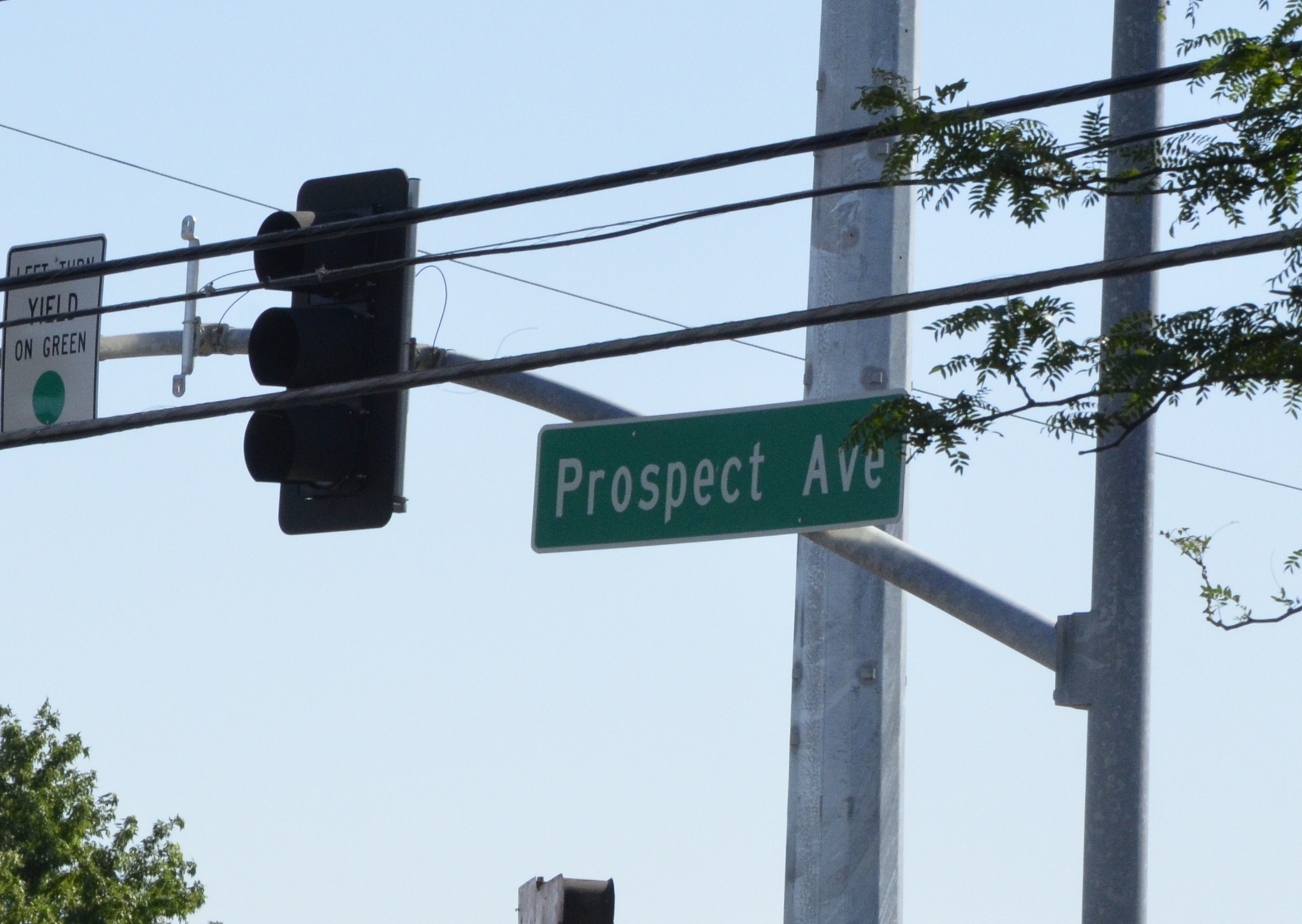
Prospect is OK when the sun is shining.

Prospect is OK when the sun is shining.

The Liberty Memorial and the Kansas City skyline in the distance.

The Liberty Memorial and the Kansas City skyline in the distance.

Salty and sweaty at the finish.

Salty and sweaty at the finish.

Hanging with Rick and Danny after finishing. Great day to run with some great folks!

Hanging with Rick and Danny after finishing. Great day to run with some great folks!

DNF AT THE FLATROCK 101K

Posted by Chris Wristen on May 4, 2014
Posted in: Uncategorized. 1 Comment

One of the greatest parts of running trail ultras is the tremendous opportunity to push yourself on a wide range of terrain, in diverse locations, and ultimately discover your limits.

Sometimes the hardest part is accepting that your limit on a given day isn’t the finish line.

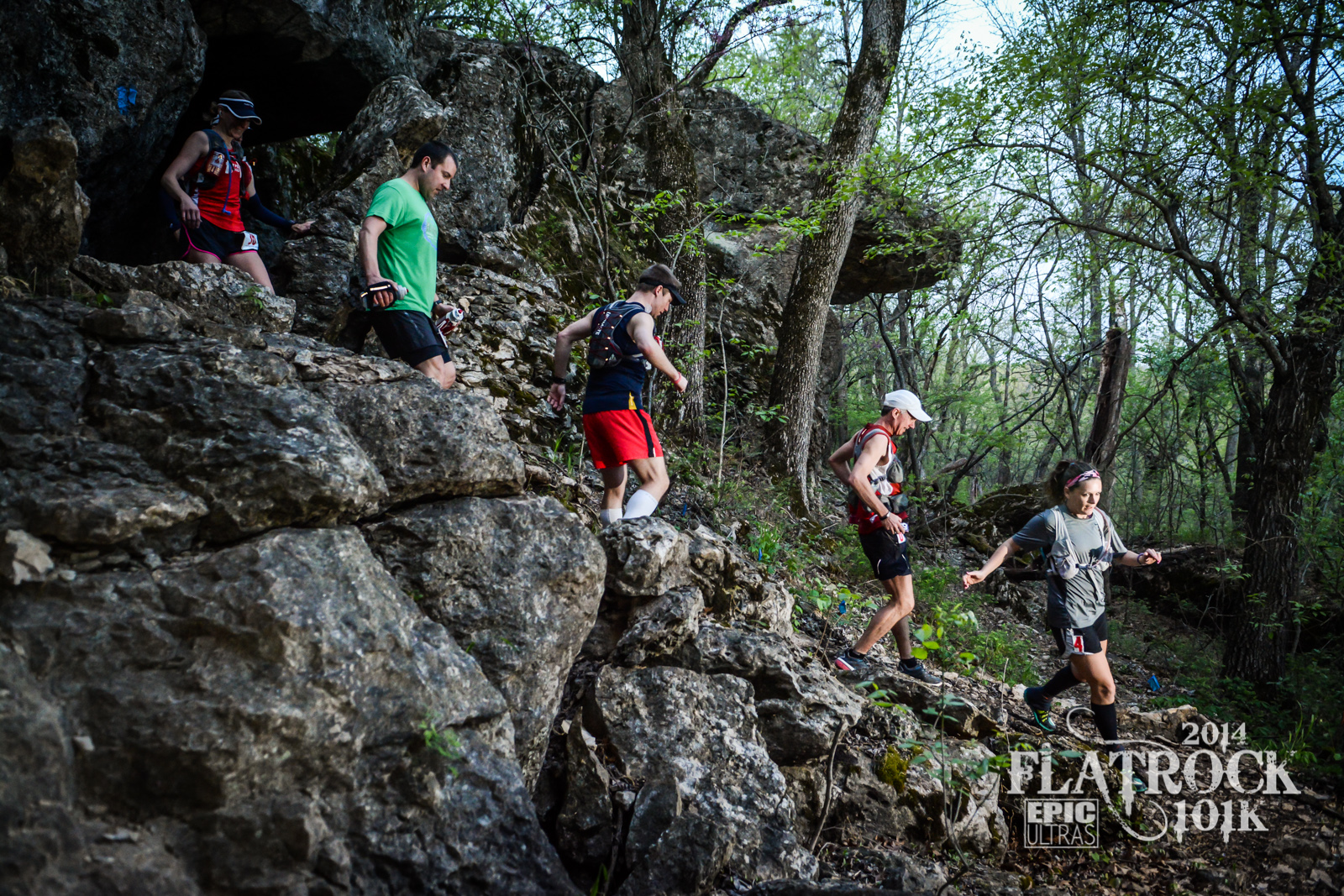
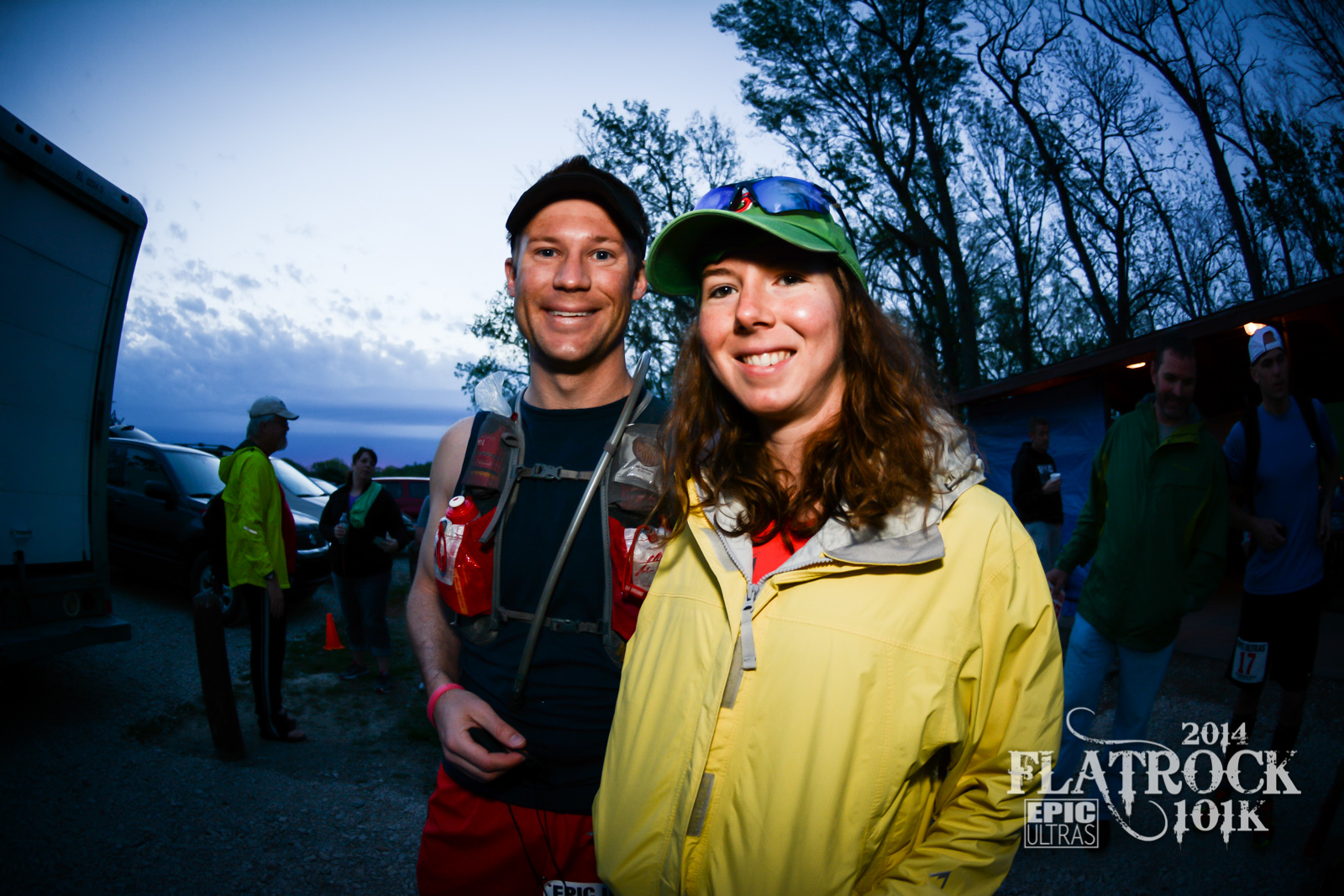
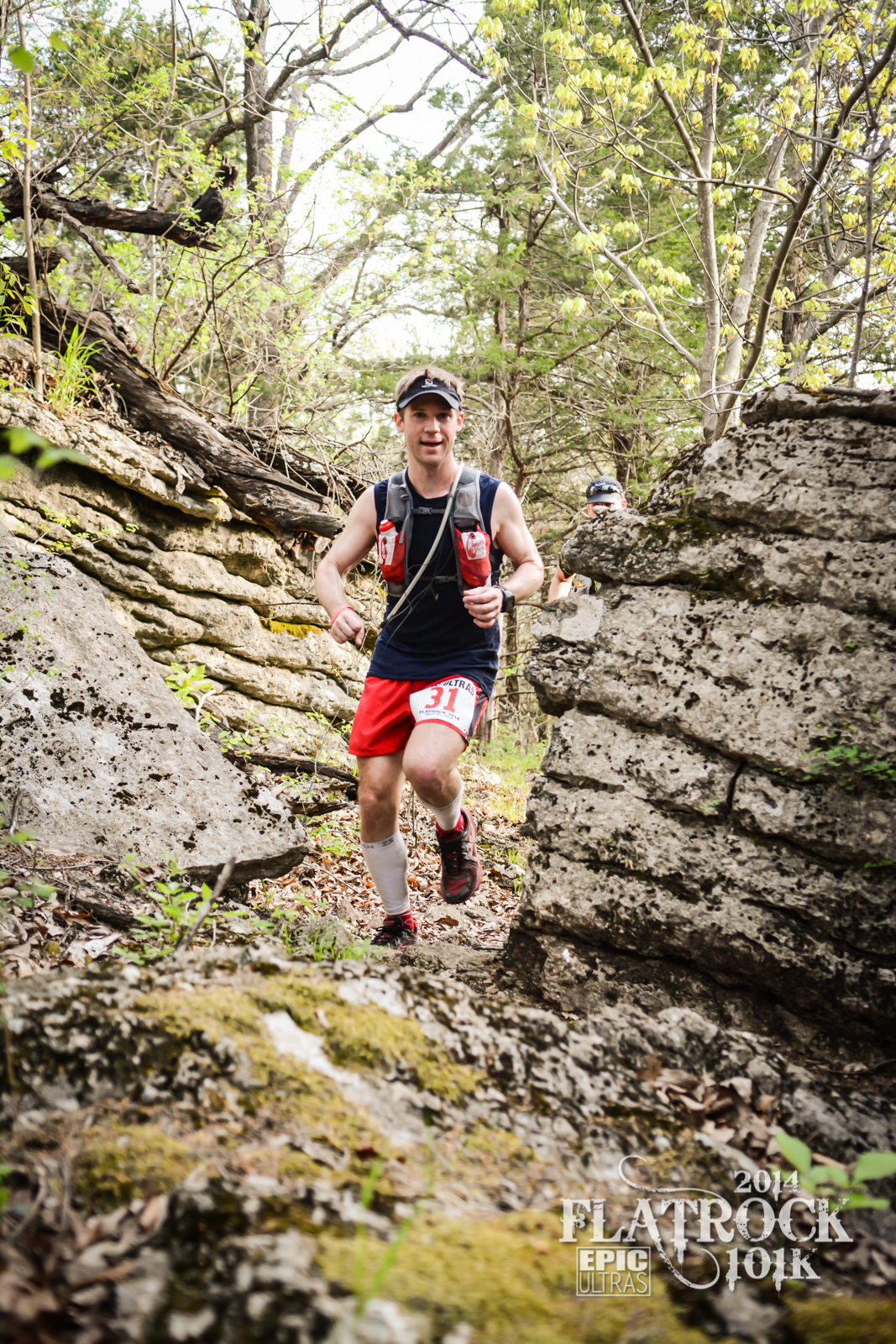
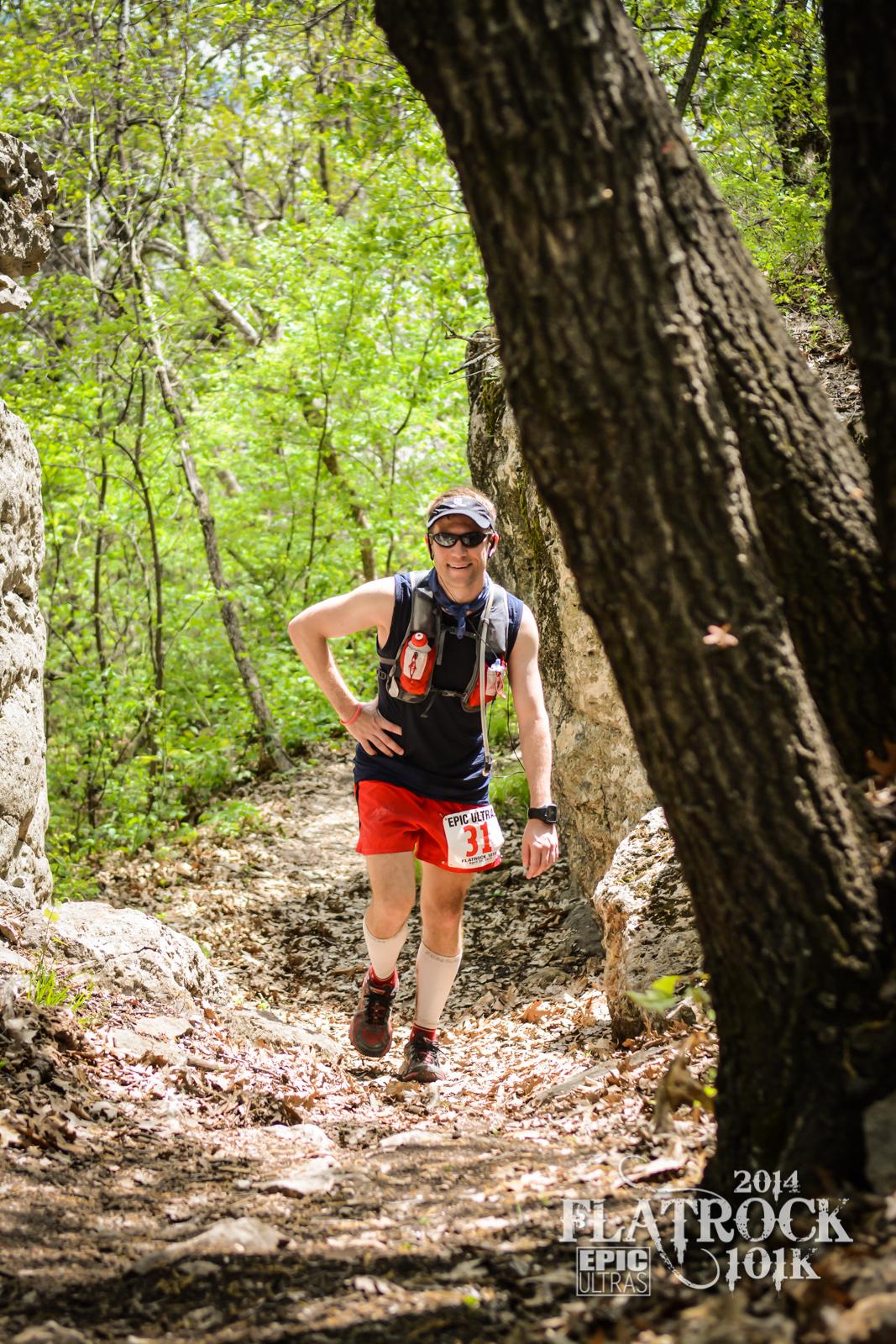
That was the case for me on Saturday, April 26, at the FlatRock 101K.flatrock101-2014-3062

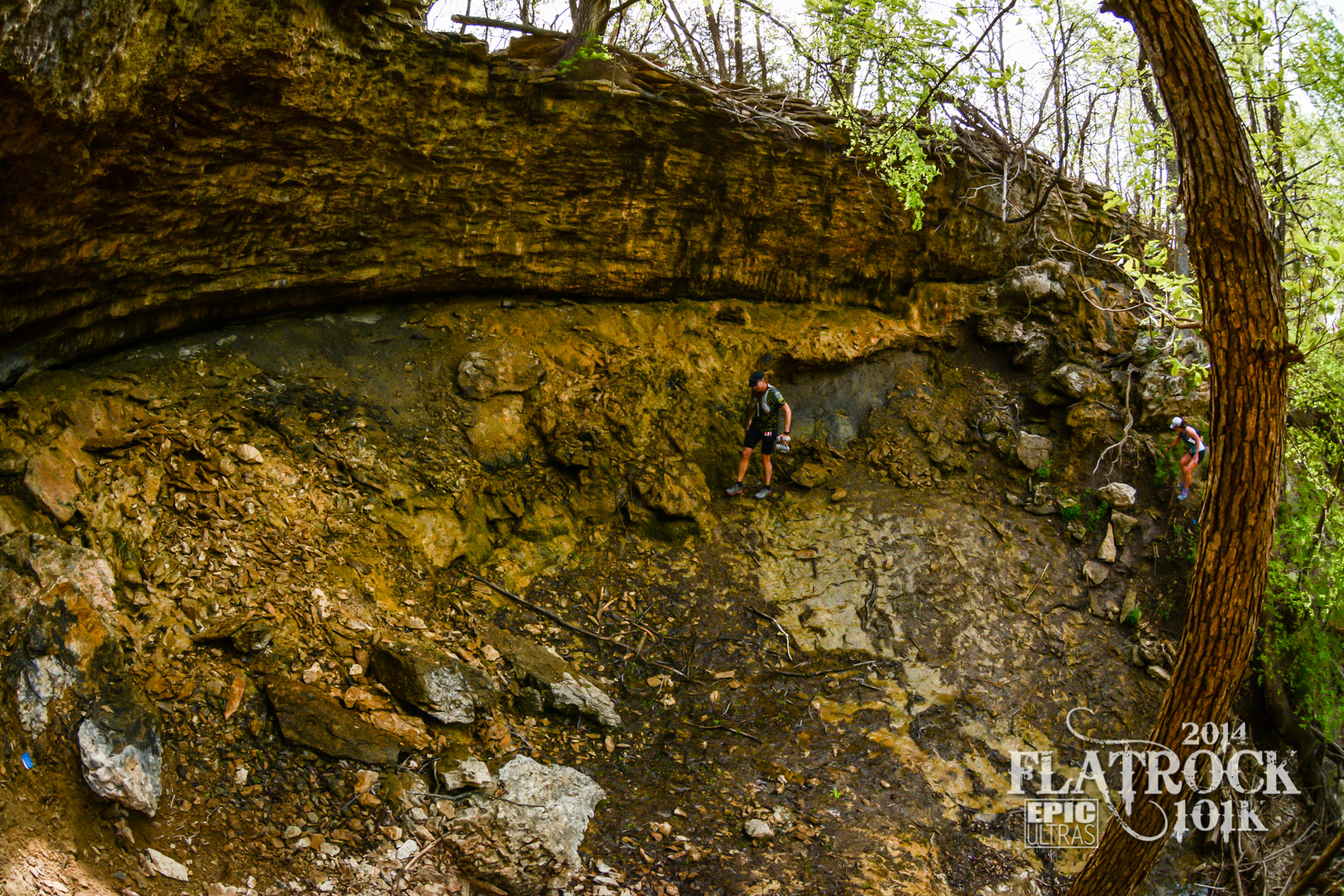
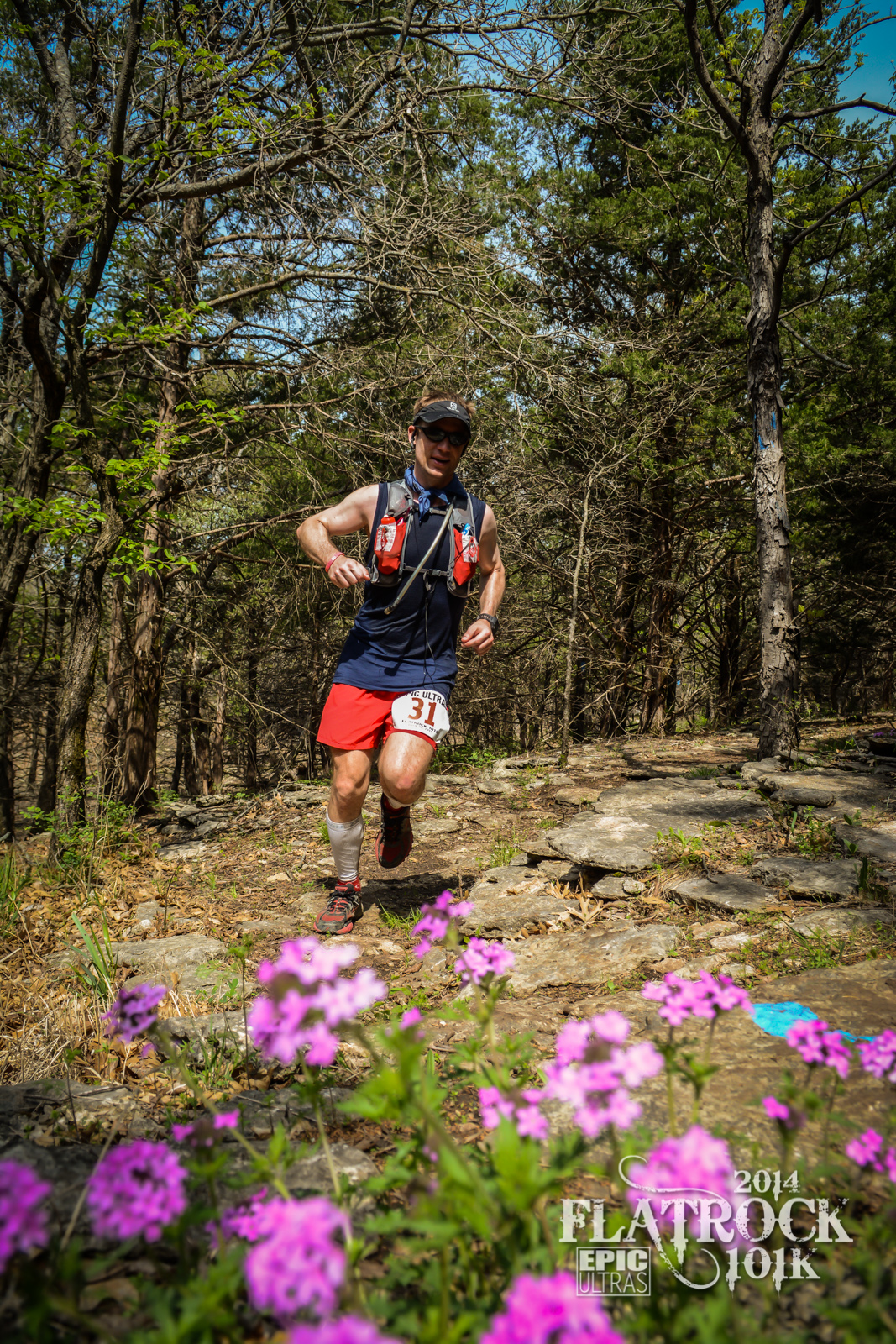
The FlatRock 101K is a double out-and-back on the Elk River Hiking Trail in Independence, Kansas. It’s the site of the FlatRock 50K – Kansas’ oldest ultra (year 20 is coming in September) – and it’s one gnarly trail with endless rocks, numerous steep climbs, and few opportunities to settle into any sort of running rhythm.

It’s tough running any day, but the conditions on race day added to the difficulty.

On the hottest day of the year where temperatures soared to around 90 degrees and the humidity pushed 65 percent, my race was ravaged by calf cramps, lack of energy, and ultimately overheating.

I had a great first 15.6 miles, running most of the way with Sherrie Klover and Larry Long and the full distance with Stu Johnson. We hit the turnaround in a little over 3:15, and I was feeling good. A strong wind blowing off of the lake kept us cool during the early hours, and it helped mask the effects of the humidity for a while.flatrock101-2014-1784

I felt the humidity’s wrath shortly after departing the aid station for the return trip. Within a mile of returning to the trail my calves began trying to cramp. I took a hiking break and resigned myself to the fact that this day just became a whole lot longer. I hydrated well early and took salt on the hour, every hour, but something about my levels was wrong and it caught up to me much earlier than I’d hoped it would.

The remainder of the return trip was a mixture of running the minimal flats and downhills while hiking every hill to fend off cramps. My energy levels were dropping quickly, and by the time I reached the road leading back to the start/finish to conclude my first out-and-back I knew I’d be forced to hike the second half of the race as the temperature continued to rise.flatrock101-2014-3404

Alex was waiting for me at the aid station, ready to tend to my food and fluid needs before hopping in to pace. I told her to be prepared for a nine- to 10-hour death march on the second half of the race, and she was prepared to do whatever necessary.

Unfortunately, my legs and body didn’t have the same amount of gusto.

We had 3.8 miles to reach the first aid station, and by the time we got there I’d grown light-headed and was overheating. I grabbed a seat on a cooler and downed a few cups of ginger ale while Alex put ice on my neck and rubbed cubes on my wrists and knees to help cool my body down.

It took about 15 minutes, but my body calmed down and we returned to the trail to hike the next six miles to the 41-mile aid station. I knew I had a decision to make during that stretch. It quickly became apparent that my energy reserves were sapped, and my brain was drifting to the point that I didn’t feel comfortable that I could navigate the more treacherous parts of the course safely after dark.

What happened in Whistler last September – the cramps, light-headedness, dizziness, and eventual trip to the ER – weighed heavily on my mind. I wasn’t at that point physically, but my body was telling me it wasn’t my day. I decided to listen this time.

I made it 41 miles before ultimately pulling the plug.flatrock101-2014-1533

No regrets.

It turned out I wasn’t the only one who had a tough day. Of the 48 or 49 runners registered, 27 started and only 22 finished. Of that, only 12 finished in less than 20 hours, including a trio of my Kansas City running pals – Adam Dearing won in 12:44:22; Stu had a smashing race and took second in 15:10:26, and Sherrie was the women’s champ and fourth overall in 15:36:14.

I’m not signed up for any other races at the moment, although I’m sure that will change soon. Up next is pacing for Alex at the TARC 100 in Massachusetts in June, so between now and then I’ll let my cranky right ankle rest and scope out future races.

Another area of focus will be trying to figure out my running nutrition; specifically, why cramping continues to be such a problem for me regardless of how much or how little fluid, salt, food, etc. I ingest. Something’s not right, and Alex is going to try to help me figure it out beginning with sweat rate testing and some additional running nutrition homework. That may be the big running goal for the summer so that the next time I toe the starting line my day will end at the finish line.

flatrock101-2014-3650

flatrock101-2014-3158

flatrock101-2014-3567

flatrock101-2014-1539

flatrock101-2014-1507


REDEMPTION AT ROCKIN’ K

Posted by Chris Wristen on April 8, 2014
Posted in: Uncategorized. 1 Comment

Rockin’ K is a mean, nasty trail race. It’s Kansas at its cruelest.

Race it smart, and it’ll leave your legs feeling trashed. Race it dumb, and it’ll chew you up, spit you out, and leave you for the turkey buzzards to feast upon.

There’s no middle ground at this Kansas classic. The open, fully exposed prairie of the heartland’s Smoky Hills is absolutely unforgiving with its steep sandstone bluffs; frigid waist-deep water crossings; sharp, wild prairie brush that slices and stabs the skin; sand; constant exposure to sun; and a relentless headwind that seems to follow no matter which direction you’re headed.

The race starts at sunrise in the Smoky Hills of Kansas.

The race starts at sunrise in the Smoky Hills of Kansas.

Two years ago, I ran the Rockin’ K marathon for the first time. I ran it dumb, delivering self-inflicted damage from almost the moment I woke up on race day, forgetting to apply sunscreen, starting way too fast while neglecting to hydrate during the first hour, wearing Montrail Mountain Masochist shoes with OutDry – a GoreTex-type of waterproof coating that was designed to keep water out … but also didn’t allow water to drain from any of the dozen water crossings. The course broke me mentally in 2012, and by the time I finished the race I was sunburned to the point my skin had blistered, my calves were cramping, and I was angry with myself. It had been a long and miserable 5:43:39.

When I signed up for Rockin’ K this year I was determined to have a much different showing. I was determined to run it smart, knowing full well the consequences of doing otherwise.

On Saturday at Kanopolis State Park, I had my redemption run.

We were blessed with perfect weather on race day: morning temperatures around 32 degrees with an afternoon high in the low 60s; winds reaching only about 20 MPH (gentle by Rockin’ K standards); and a few of the early water crossings were dry.

I prepared appropriately with a good breakfast, an early application of sunscreen, and a small bottle of Pedialyte in my hydration pack to help support sustained hydration alongside a liter and a half of water with two Nuun tablets.

I started nice and easy during the first half-mile on pavement, intentionally holding myself back a bit until we bailed off the road and onto the trail. I maintained the easy pace, scooting around a few other runners, and worked my way up to where Larry Long and Sherrie Klover – my weekend long-run buddies (and Rockin’ K 50-milers) – were running together. I settled into a steady rhythm behind Sherrie, determined to stick to her disciplined pace and ignore my urge to go faster. There would be time to push it later – assuming my legs would allow it.

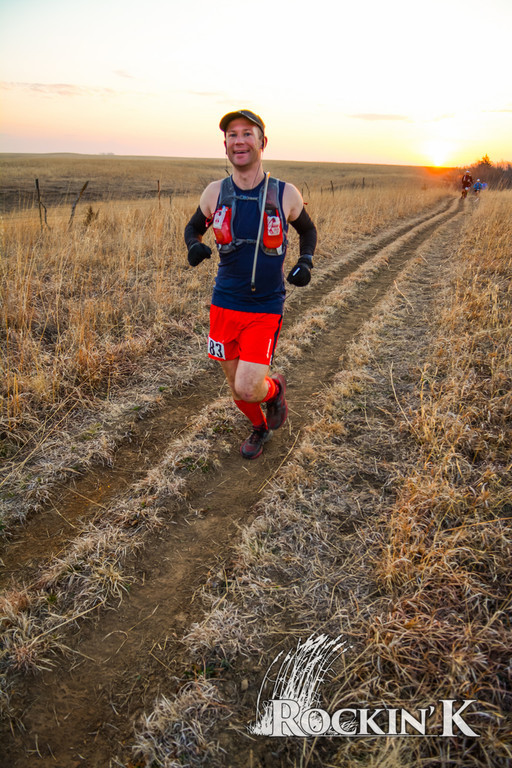
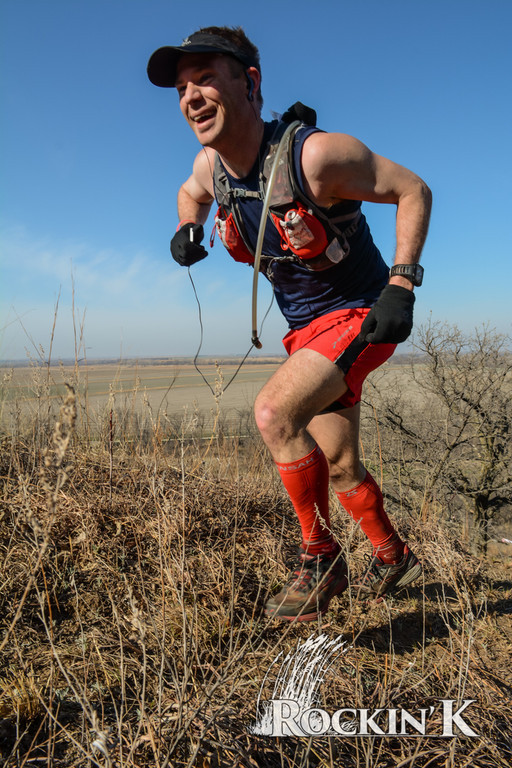
Ascending to the top of the Big Bluff Loop at the 2014 Rockin' K at Kanopolis State Park.

Ascending to the top of the Big Bluff Loop at the 2014 Rockin’ K at Kanopolis State Park.

Larry, Sherrie and I ticked off the early miles with a comfortable 10:30 pace, chatting away and admiring the scenery as the run rose across the prairie. The lone glitch in my day came 8.3 miles into the race when, moments after spotting a few deer bounding down from a high bluff, my distracted eyes failed to spot a hole that I stepped in. I turned my right ankle hard, not enough for a sprain, but enough that pain shot through my foot. Whether running or hiking, I could feel it tightening up quickly. I had to get moving if the ankle was going to loosen out and let me finish, so I picked up the pace for three solo miles before catching up to 50-miler and Rockin’ K veteran Stu Johnson. We arrived at the Gate 6 aid station (mile 13.24) in about 2:27, right on pace where I’d been two years ago, but feeling much better this time. I slammed a cup of Coke, and then Stu and I headed out for the Big Bluff Loop, a nasty five-mile loop featuring two steep climbs, lots of sharp, prickly, blood-drawing brush, and a scamper across a beaver dam. We stuck together until around mile 15 when my legs were ready to take off. I zipped up and down the bluff a bit faster than I probably should have, and then popped back out into the open prairie and worked my way back to Gate 6 (approx. mile 18.6). Co-Race Director Elden Galano refilled my hydration pack while I refilled my Pedialyte from my drop bag. About three minutes later, I headed back out for the final 8 1/2 miles.

Less than a mile out of the aid station, the effects of the Big Bluff Loop set in on my legs. They felt like bricks. I thought my calves wanted to cramp. I considered hiking for a bit, but then opted against it. I downed some more Pedialyte, re-applied some sunscreen and decided to push the legs until they cramped, and then I’d hike it in to the finish line if necessary. We’d find out how long my legs would hold up.

Outside of brief hiking breaks on occasional hills, I ran the rest of the way. My legs constantly felt on the edge, but they let me settle into around an 11:20 pace and hold it. My back-to-back weekend long runs during training paid off. Each time I crested a hill or scaled another fence I had flashbacks to 2012 and where I’d been mentally at that point on the course. I found myself laughing at the difference two years and a little bit of early discipline had made.

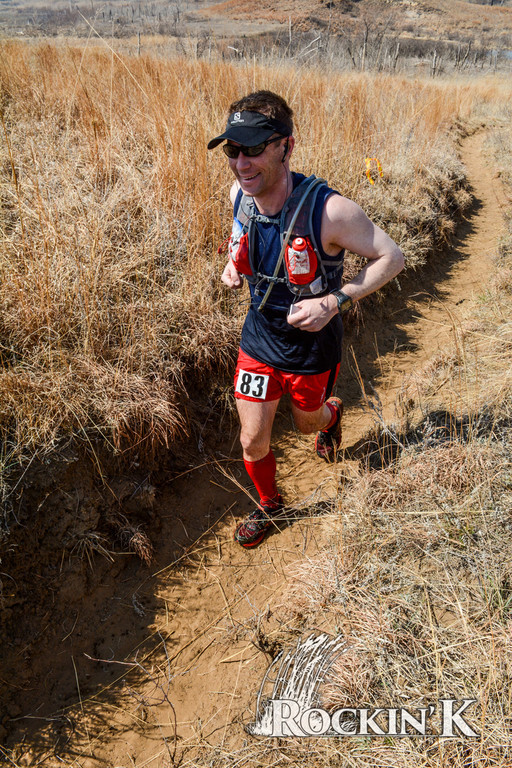
Pushing the pace between the two pond crossings late in the race at the 2014 Rockin' K.

Pushing the pace between the two pond crossings late in the race at the 2014 Rockin’ K.

The two ice-cold, waist-deep pond crossings numbed up the soreness in my toes and calves enough for me to make the final push to the finish line, and I was able to kick it up the hill to the finish line with a smile on my face.

My time of 5:12:16 in the 27.2-mile heavy marathon was good enough for 11th-place male (12th overall) and about 32 minutes faster than in 2012 as I collected my second Rockin’ K finisher’s horseshoe and another finish-line hug from race co-founder Stacy Sheridan.

UP NEXT

Rockin’ K served as my final long training day to prepare for my longest race ever, the FlatRock 101K on April 26 in Independence, Kansas. My legs and right ankle are pretty beat-up from Rockin’ K – which was to be expected – so they’re getting an easy week for recovery before hitting the trail hard again.

I’m feeling optimistic about FlatRock for a number of reasons, among them being my encouraging run at Rockin’ K and the fact that Alex will be in town from Boston to look after me and run the second half of the race with me. After that, I’m looking forward to easing back on mileage a bit, pacing Alex at her 100-miler, and hitting some hiking trails in Colorado.

The bluffs and sandy horse trails make for some rough maneuvering in the Smoky Hills of Kansas at Rockin' K.

The bluffs and sandy horse trails make for some rough maneuvering in the Smoky Hills of Kansas at Rockin’ K.

Two frigid, waist-deep horse ponds in the final mile and a half of the course will slow your pace and reinvigorate your legs.

Two frigid, waist-deep horse ponds in the final mile and a half of the course will slow your pace and reinvigorate your legs.

Horseshoes are the coveted finisher's hardware at Rockin' K. This is my second horseshoe so far.

Horseshoes are the coveted finisher’s hardware at Rockin’ K. This is my second horseshoe so far.

2013 IN REVIEW: MORE MILES, HARD LESSONS, AND A HAPPY HEART

Posted by Chris Wristen on January 11, 2014
Posted in: Uncategorized. Leave a comment

Two common themes dominated my 2013 trail-running season: over-scheduling and overtraining.

I entered the year with a pretty ambitious schedule: races in four different states and two countries, including two three-day stage races.

I survived the schedule and ran the most miles in a year in my life — 1,300.5 — surpassing the 1,251 that I ran in 2012, but the schedule took a serious toll. I had my best racing season in some respects, but a lack of scheduled rest and recovery time took a pretty harsh toll on my body. I trashed my calves in the first race of the year, struggled with mid-summer training, and landed in the emergency room in Canada after finishing my second 50-miler.

2013 Mileage Chart by Month

2013 Mileage Chart by Month

But I also met some fantastic new friends along the way, including folks like Meghan Hicks of irunfar.com and mountain-running beast Jeremy Day at 3 Days of Syllamo, and a whole slew of people at the Chattanooga Mountains Stage Race. And then there was our condo crew in Whistler who made for one big happy family, one of which came to my rescue on race day and snagged my heart in the process.

The year opened Jan. 20 at the Big Bend 50K at Big Bend National Park – one of the most remote national parks in the United States, and a stunningly beautiful desert location. My goal was to push the pace, toeing the line between flying and imploding for as long as possible until things turned ugly. I cruised for 16.5 miles before cramps brought my race crashing down. I finished 18th overall with a massive 50K PR of 5:14.20, but I ended up destroying my calves due to the cramping and it took about two months for them to fully recover. That meant I went into 3 Days of Syllamo undertrained. That three-day stage race in March in the Ozark Mountains of Arkansas was even more of a challenge than it was expected to be. I finished the 50K on day one and the 20(ish)K on day three, but I dropped 19 miles into the 50-miler on day two.

April marked a nice bounce-back as I finished 10th at the Free State 40-miler at Clinton State Park in Lawrence, Kansas.

In June, I headed to Tennessee for the Chattanooga Mountains Stage Race, a three-day event that covered three different mountains and 60 miles. It was more rugged running than I’d anticipated – the third day in particular – but I finished all three days and had an absolute blast at the well-organized event. Even better was the crew of Texans that I traveled with, as well as the fine folks who I met while staying at the Crash Pad hostel. There were so many inspiring runners and genuinely good people.

My running took a turn for the worse after Chattanooga. The Kansas City summer had such inconsistent weather – hot and steamy weeks in the 90s followed by cool and comfy weeks in the 50s – that my body never really adapted. I struggled on so many training runs and cut a lot of them short. My body was fatigued and I was mentally drained.

I headed to Colorado in mid-August to pace for Sherrie at the Leadville Trail 100, and the 26 miles of trail time – including the scenic return trip over Hope Pass – were the last bit of good running that my legs had in them for the summer. Two mostly sleepless weeks followed thanks to a nonstop fire drill at work, and then I headed to Whistler exhausted and run-down for the Meet Your Maker 50-Miler.

My body wasted no time telling me it was through with me on race morning. A finish line still awaited me, but so did two hospitals and an ambulance ride.

I pretty much shut down my running for a few months after MYM50. Some weeks I didn’t run at all. Others I totaled mileage into the upper 20s. Nothing was planned; nothing was serious; I had no training targets, and it was wonderful. I absolutely winged a 50K at the Kansas Ultrarunners’ Society 6-Hour Run on Nov. 16 in Wichita and finished eighth with 31.98 miles in a little less than six hours – not bad for having one double-digit mileage run in the previous 11 weeks!

After the 6-Hour event, I took it easy for the next month before cranking out five straight days of 10-milers leading up to Christmas. That allowed me to finish 2013 strong, hit a new yearly mileage PR, and head into 2014 feeling like my base is strong.

I’m not signed up for any races yet for 2014, but I’m beginning to feel inspired. I have a happy heart and renewed motivation heading into the new year. I’ll most likely run a few events I haven’t done before on trails I’ve never seen, and I’m eyeing some new distances as well.

I won’t race as much as I did in 2013, and I may or may not run more miles – the total number doesn’t matter much anyway – but the focus will remain the same: run happy, stay healthy, and keep pushing forward.

MEET YOUR MAKER 50: THE PRICE OF DIGGING DEEP

Posted by Chris Wristen on September 5, 2013
Posted in: Uncategorized. 3 Comments

WHISTLER, BRITISH COLUMBIA – This wasn’t the post-race photo I envisioned taking prior to the Meet Your Maker 50-mile trail race.

IMG_0160

The reality of our sport of ultra-running, however, is that races don’t always go as planned. Sometimes things go terribly wrong; the body doesn’t cooperate; we push the limit and pay dearly for it.

I imagined a photo gathered with my friends at the finish line, smiles on our faces, proudly displaying our finisher’s medals after successful completion of this bear of a race.

Maybe what happened was unavoidable. Perhaps I was too foolish and stubborn to quit and pushed too far. The journey from the rugged mountain trails to the medical center in Whistler and ultimately an emergency room in Vancouver was more than 12 hours in the making.

That’s why this photo captured my reality perfectly. On a day where nothing went as planned, I still got the post-race photo with my friends, only it was taken – as Alex later put it – in a unique venue.

In hindsight, the ending makes perfect sense. My race unraveled extremely early and grew progressively worse by the mile. At the same time it’s still hard to wrap my head around it because the day started so good …

THE MAKER AWAITS

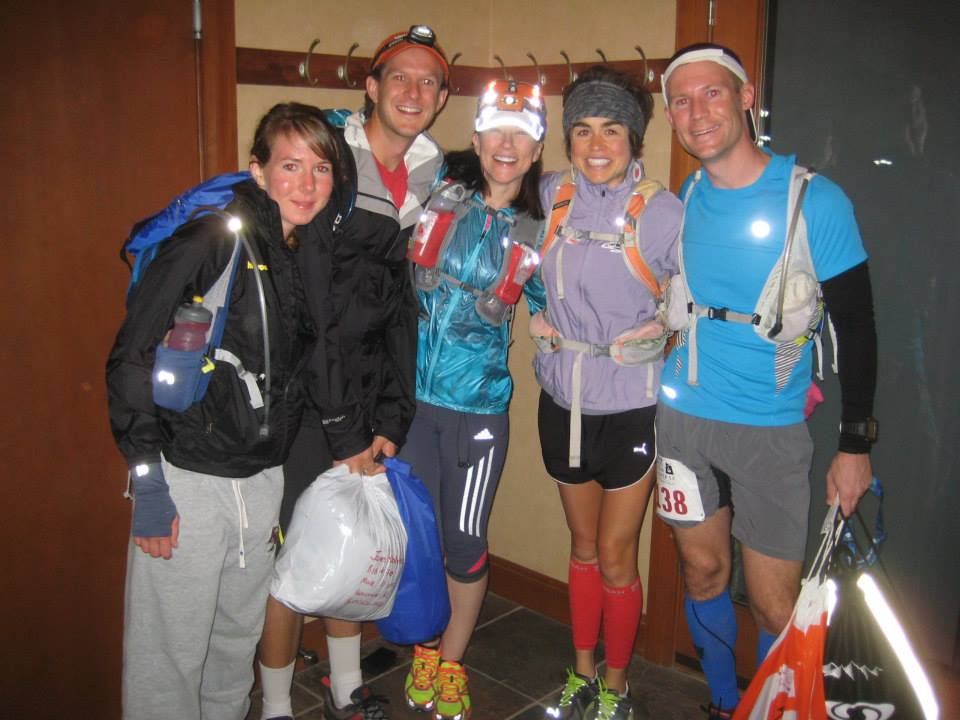
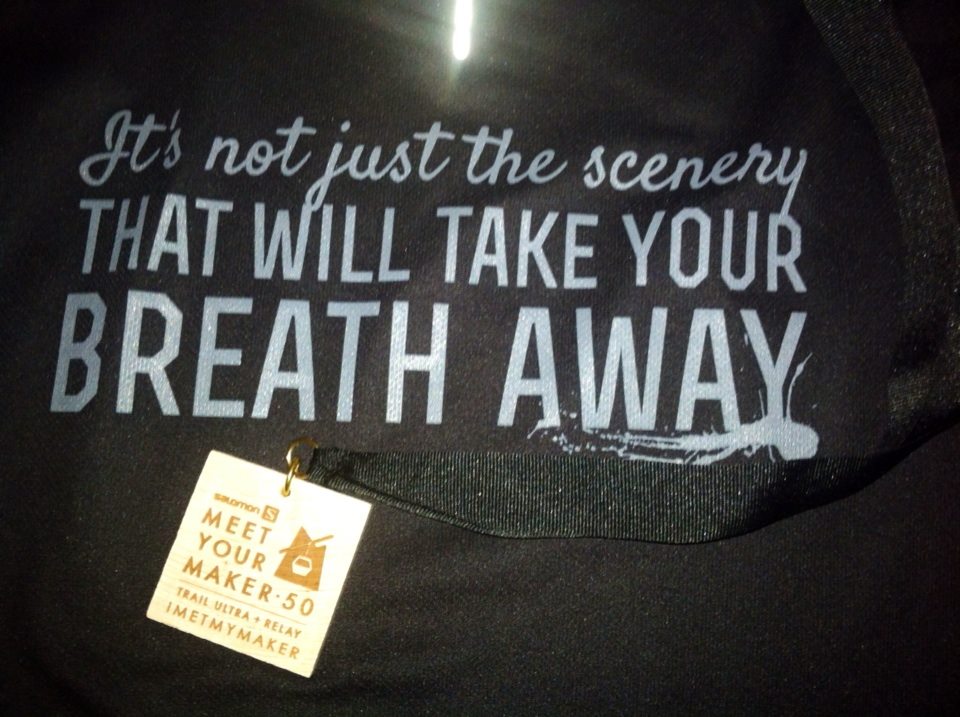
The condo was buzzing by 3 a.m. Sunday. Shower water drizzled, feet pattered on the kitchen floor, and the aroma of stovetop coffee filled the air as we prepared for the 5 a.m. start of the Meet Your Maker 50, a 50-mile trail race that circled the mountains surrounding Whistler and featured a monster climb up Blackcomb Mountain, a steep and rugged descent of Whistler Mountain, and more than 11,000 feet of overall vertical gain. Alex, James, Katie, Laura and I filled our hydration packs, double-checked drop bags and got ready to run while Veronica and Joakim prepared to offer lots of moral support.1239914_666663394242_1925741720_n
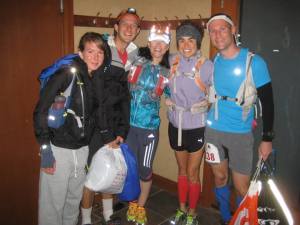
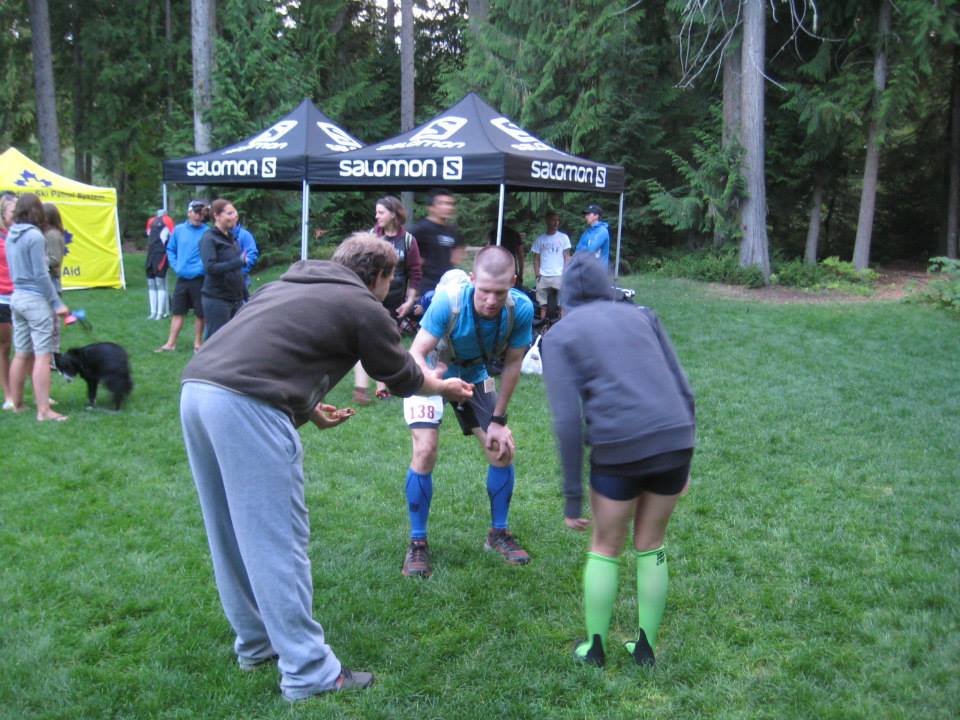
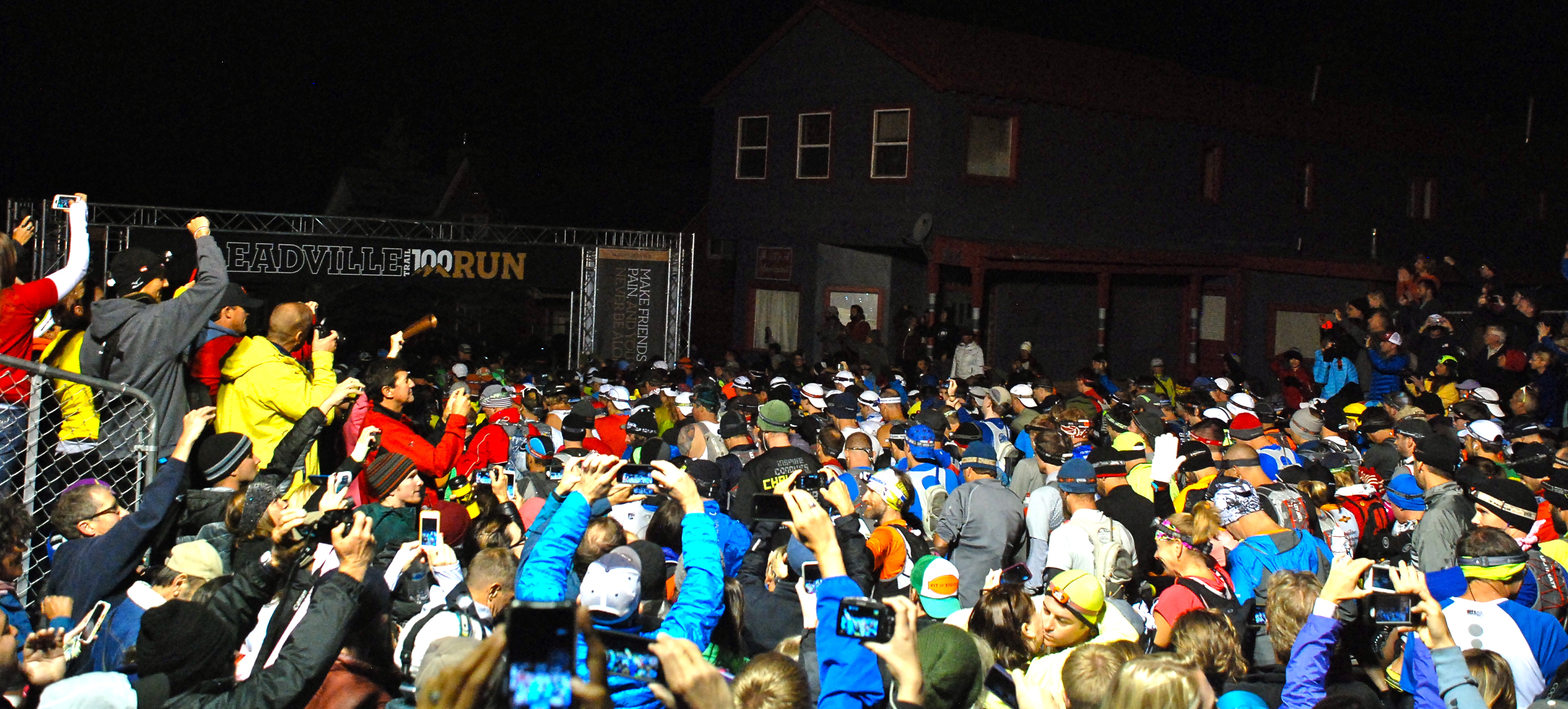
We arrived at the starting line in Rebagliati Park at 4:45, placed our drop bags in their designated bins, snapped a few photos, and joined the other 105 solo starters and about 40 relay teams at the line. We received final instructions, and then we were off. The crowd cheered as the swarm of headlamps trotted past and hit the trail.

James and I stuck together. It was his first 50-miler and my second, and neither of us wanted to go out too fast. Leg One of the seven-leg race was mostly smooth, rolling trail. We made good time, covering the six-plus miles to the first aid station at about a 12-minute mile pace. We chatted the whole way, enjoyed the views that the moonlight provided as it reflected off of Lost Lake and the glaciers that capped surrounding mountain peaks.

I topped off my hydration pack, snacked on some chips and a boiled potato at the aid station, and then headed out for Leg Two – a winding, root-covered mountain bike trail called Comfortably Numb. I felt great. The early pacing was perfect, my heart rate was calm, and my nutrition was good.

Two miles into Comfortably Numb, everything changed.

HEART RATE RISING

It was subtle at first, but my heart rate began to increase shortly after James and I began Leg Two on the winding, up-and-down Comfortably Numb trail. That’s nothing unusual. It happens frequently during races when the trail starts to climb, humidity gets sticky or I get going too fast. I did what I always do when that happens; I started hiking and taking slow, deep breaths to calm down my heart and get it back in check. My body calmed down a bit and I resumed running, but the heart sped right back up. I hiked again, took more deep breaths and tried to calm the body back down. It didn’t respond. This was unusual, although not too concerning considering the rate hadn’t ramped – it was just felt a little higher than I prefer.1184916_10101560829686759_1162324667_n
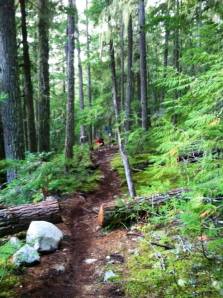
I told James not to wait for me, instead to go on ahead and run his own race. That’s critical in ultras since there’s no telling how any runner will feel or how their body will behave on a different day. He was stronger, his pace faster, and he needed go.

I hiked a good portion of the final 11 miles of Comfortably Numb. The heart continued to fluctuate and never returned to my comfort zone. It probably didn’t help that three mud wasps stung my right leg during miles 13 and 14, and the possibility of an allergic reaction (there wasn’t one) lingered on my mind. After banking 40 minutes against the cutoff on Leg One, I’d added a bit to the cushion on Leg Two despite all of the hiking. I arrived at the second aid station, downed some ginger ale, refilled my hydration pack and wolfed down a few more potatoes before heading out for Leg Three, a seven-mile trek up Blackcomb Mountain.

Leg Three featured 3,800 feet of vertical gain, and it began with a steep, 500-foot march up the side of Blackcomb underneath the ski lift. Steps were slow – one foot barely in front of the other, and part of the time I marched with my hands gripping my quads for added support. I stopped every few minutes to gaze at the surrounding view and catch my breath, and soon I could feel my heartbeat in my ears thumping like a base drum as it ramped for the first time.

Eventually we tailed off to the left and hopped onto a service road that wound its way further up the mountain. I paused for a few seconds, put my hands on my head and breathed deep to slow my heart down. It dipped back to its elevated state, and I began hiking the road. Alex caught up to me within a mile, and we spent most of miles 22 and 23 hiking together at a 19-minute clip. We made good time, chatted a bit about the three mud wasp stings each of us endured on Comfortably Numb, and enjoyed the ever-expanding views as we climbed higher up Blackcomb.

These were the final two “happy miles” I had all day.1234479_10101560836632839_777217792_n

The road grew steeper, my heart rate rose again, and I fell back off the pace as Alex pulled ahead.

Eventually the course veered off of the service road and onto a stretch of single-track that zig-zagged a few hundred feet higher. By now I was moving at around a 26- to 28-minute pace and pausing every few minutes to breathe deeply and calm the body down. My quads were shrieking from the climbing, and my calves and hamstrings were equally angry about the lack of oxygen being pumped to them. My ears were pounding again. Deep breaths became difficult to suck in with my system out of cadence. It took nearly 29 minutes for me to complete mile 25, and almost 26 minutes to complete the 26th mile and reach the aid station at the Peak-to-Peak gondola lift.

I was about 22 minutes ahead of cutoff. My goal had been to reach the aid station in 6 1/2 hours feeling good. It took more than 7 and my legs felt destroyed. Quitting wasn’t on my radar, but time wasn’t on my side.

COMING DOWN THE MOUNTAIN

Needing to make up time after a sluggish climb up Blackcomb, I hopped off the gondola atop Whistler Mountain, plugged in my headphones and let Van Halen’s “Right Now” carry me downward over the steep grade of a rocky service road for three miles at about a 10-minute pace. I blazed where I could, tip-toed through loose rocks when necessary, and rebuilt some space against the cutoff.

Eventually the course veered onto a single-track section that consisted primarily of large, slick rocks. The footing was treacherous, and I cleared a few of them by sitting down and sliding on my butt rather than risking a fall. The terrain forced my pace to slow a bit. Finally, I popped back out of the woods and onto the service road that led to the aid station.

I refilled my hydration pack with water and two Nuun tablets, slammed two cups of Coke, ate a boiled potato and a PB&J, and headed back out. I thought the tide was turning, but within the first mile of Leg Five I already gave back any extra time I’d made on the cutoff.

BREAKING POINT

Leg Five begins with a 900-foot climb that spans nearly two miles, and this stretch was my breaking point. My body whispered that it was done, and my mind strained to listen.

I could no longer move at a pace that matched the beats on my iPod, so the sounds made me angry. The headphones went back in my pack. No more music; just me and my thoughts.

Three times I sat down on logs during mile 32, each time feeling lightheaded and dizzy, sweat gushing from my chest and back, and my calves, quads and hamstrings begging to stop. Mile 32 took almost 31 minutes. Mile 33 was a winding road through a neighborhood, and that stretch – despite being smooth and involving some downhill – took more than 20 minutes.

The course cutoff again was calling for me, and this time I felt hopeless. I would keep putting one foot in front of the other until a race official told me to stop, but I was certain that time was coming soon.

Another runner who knew the area and was familiar with the course infused me with hope when I needed it most. She had just come off of a dark patch, and the Coke from the aid station finally kicked in for her. She was back in a groove, and she informed me that when we reached the end of the road there would be a long stretch of downhill running.

“Just give it a little time, and you’ll be fine,” she said.

I knew I wasn’t going to be fine until this race was over, but I also knew I could take advantage of the downhill to make another cutoff.

For the next three miles I ran the downhills as long as I could before my legs would try to lock up, and then I’d hike again. Deep breath in, deep breath out, deep breath in, deep breath out, run, run, run. I knocked out two 13-minute miles and a 12-minute mile before my head began to spin again and my heart rate spiked once more. I hiked the final, mostly-flat mile to the aid station in just over 17 minutes.

I’d survived another cutoff, but the medical team member at the aid station was concerned. She asked how I felt, and I told her my heart rate was high and my legs had tried to cramp for miles. She asked if I was lightheaded or dizzy. I told her I’d been lightheaded a few times. She had me take a seat in the shade and put a bag of ice on my neck while I downed a Coke, two cups of electrolyte drink, and ate some chips.

About five minutes later I told her I was OK and headed out for Leg Six – a six-mile stretch that included 1,200 feet of climbing during the first three miles. I made it 3/4 of a mile out of the aid station and part way up the climb before throwing up everything I’d just taken in and taking a seat on a log. My heart rate ramped once more and my mind was woozy.

I should’ve dropped at the last aid station. There was no doubt in my mind that it would’ve been the smart thing to do. I’d been miserable for most of the last 30 miles – save for the two hiking with Alex – and there were still more than 11 to go.

DIGGING DEEPER

I spent a few minutes sitting on the log trying to clear my mind. I didn’t want to backtrack to the aid station. I wanted to finish. I’d come this far and suffered so much that there was no way in hell I was going to quit without someone forcing me to stop.

I thought about Leadville two weeks earlier. I saw first-hand as a pacer just how many dark miles Sherrie endured. It got to the point that she could no longer run late in the race, but she kept marching forward, dug deeper and deeper until she found herself at the finish line.

Sherrie didn’t quit. You don’t quit. Dig deeper, boy. Dig deeper. Get your ass up and move.

A few more log sits and a slow, steady march helped the next few miles go by at around a 24-minute pace. Finally, the climbing ended and I resumed the “run as long as you can until the legs try to cramp” strategy for three quicker downhill miles into the final aid station. I had about a 40-minute cushion on the cutoff, I was told, so I had time to sit for a few minutes and slurp down some chicken broth and ginger ale. I didn’t linger long. The final section had a few rolling climbs, but it was primarily flat or downhill. I just needed to keep moving for 6 1/2 more miles and I’d find the finish line.

I set out at a comfortable, relaxed pace for the first mile to make sure the chicken broth had a chance to soak in. I knew those calories were important to get me through the final stretch. From there, I trotted the downhills and death-marched anything flat or uphill. I kept doing math in my head, calculating my time against the cutoff to distract the brain. I repeatedly thought about Sherrie’s gritty effort at Leadville, her determination and no-excuses attitude. I thought about my friends who I was sure were already at the finish line. Alex and James had to be done by now – I wanted to hear all about their first 50-milers. I wanted to see them. I wanted this race to end.1185337_666664062902_1224972351_n

Finally I heard the finish line in the distance. I trotted down the trail and onto the paved path that took me the final three tenths of a mile to the finish line. Soon I saw Joakim, then Laura, Katie, Alex and the rest of the gang. They were screaming. They gave me high-fives as I passed. I actually managed to smile as I went by – the only bit of enjoyment I’d had in hours – and crossed the finish line in 14:19:36.

Done. Finally.

James ran over and gave me a hug. Then Alex embraced me and I nearly fell over on her. A few seconds later, my legs began to wobble and my head started spinning.

THE AFTERMATH

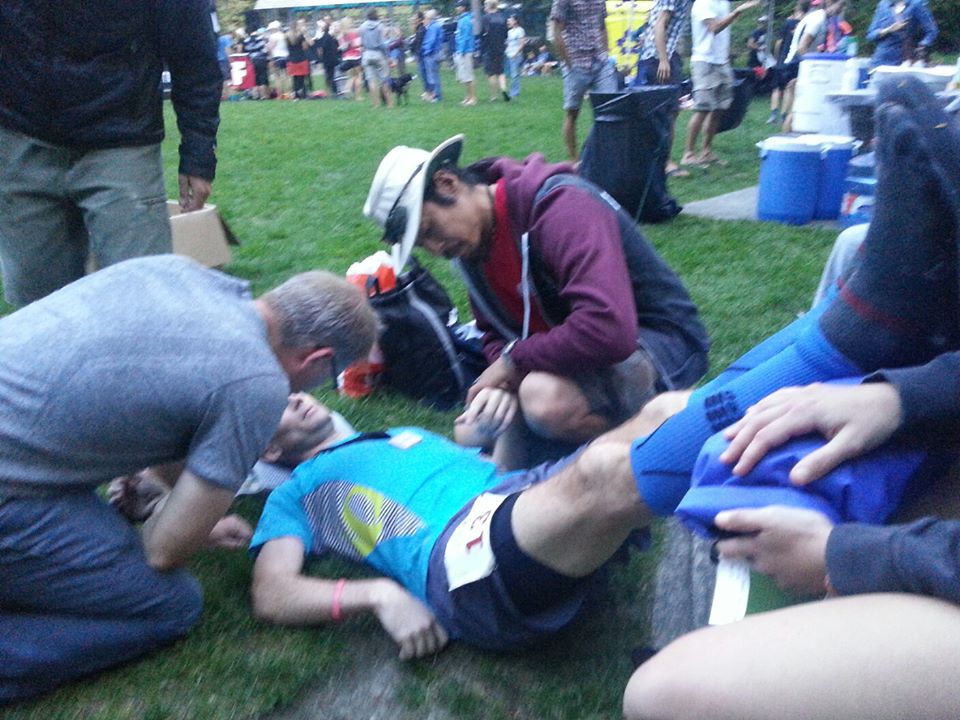
Moments later, I found myself lying on my back with my feet elevated. I hadn’t lost consciousness or collapsed, rather Alex, a nurse in Boston, had taken control and ordered me to lie down. One of the others ran to get the medical staff. Alex told them I needed to be taken to a hospital.

The next few minutes were hazy. They tried to take my pulse, but it faded in and out. I was given oxygen, which helped my head to clear a bit. Alex asked if they had IVs on site. They didn’t, but IVs definitely were needed.1305420_10201218239151445_1066670593_n
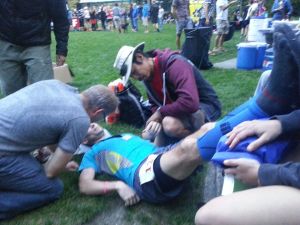
A couple minutes later I was loaded into a truck and taken to Whistler Medical Clinic.

Laura and Katie had been at the clinic when I arrived, and they’d checked me in. The rest of the crew arrived shortly thereafter and spent about two hours with me as I was pumped full of three bags of IV fluid and nurses ran various tests.

My heart rate was still abnormally high (in the 90s, I think). Blood tests were a mess, but all abnormalities were easily attributable to the recently completed race. The on-site doctor was concerned about the results of the EKG, however, when it revealed an irregular heartbeat.

Eventually, the doctor determined that they didn’t have enough resources at the clinic to monitor me overnight, and she was concerned enough about the irregular heartbeat that she wasn’t comfortable releasing me. She recommended I be taken by ambulance to Vancouver to Lions Gate Hospital for additional evaluation.

A few minutes after that decision was made, we finally took our post-race photo. The whole gang huddled around my bed, smiled for the camera, and we captured our final moment together before I was wheeled to the ambulance to head to Vancouver. James came along for the ride (he lives in Vancouver, and we’d planned to head there the next day anyway).

It wasn’t how I wanted to end the race, and it definitely wasn’t the way I wanted to say farewell to my friends after five days of sharing a condo and living like a family. I wanted to spend that night gathered around the kitchen table sipping victory beers and scarfing down pizza.

At the same time, maybe it was a fitting end. I don’t understand why my heart gave me so much trouble so early in the race, and why it didn’t respond to efforts to let it calm down. The race course was stunningly beautiful and a privilege to run on, but I spent to much time in a dark place mentally – most of the final 40 miles – that I’m still having trouble making sense of all that happened.

What I do understand – the one vividly clear detail I have of those minutes and hours after the race – was the concern on my friends’ faces as they looked after me, and their smiles and laughter as they sought to keep me from worrying while at the hospital. They had my back when I needed them most, and my lasting memory will be that post-race photo – that family photo – that captured such a bright spot after so many hours of darkness.

I finished, and I was lucky that I had some angels watching over me when I needed them.

(Editor’s note: Another EKG was done at the hospital in Vancouver, and it also showed an irregular beat. A cardiologist reviewed the tests and was not concerned, saying irregular beats happen in some people and aren’t necessarily bad or dangerous. Other tests showed zero damage to the heart muscle, and it is fully healthy).
1236785_10101561163557679_1607084726_n

HOPE AND DETERMINATION AT LEADVILLE – A PACER’S REPORT

Posted by Chris Wristen on August 25, 2013
Posted in: Uncategorized. Leave a comment

Cole Chlouber’s impassioned voice bounced off the walls of the Lake County Middle School gymnasium, growing louder each time he repeated a simple message: “Dig deep.”

It was 16 hours before the start of the Leadville Trail 100, and soon the runners would need to heed Chlouber’s advice if they hoped to successfully complete the journey from Leadville, over Hope Pass, down to Winfield and then all the way back to the downtown finish line in less than 30 hours.

100 miles, more than 18,000 feet of vertical gain; an entire race taking place above 9,200 feet and climbing above 12,400 feet … dig deep, indeed.DSC_0023

Sherrie Klover lowered her head and her eyes watered as Chlouber said it again: “Dig deep.”

She was nervous; she was excited; she was ready.

I was in Leadville to be one of Sherrie’s pacers, and during the course of the 100 miles – and in particular during the 26.6 miles I ran and hiked with her from Winfield, over Hope Pass and back to Outward Bound Aid Station (formerly Fish Hatchery) I saw first-hand just how seriously Sherrie took Chlouber’s message.

TICK, TICK, TICK…

Eleven hours came and went, followed by hour 12. It was 4 p.m. – exactly 12 hours since the start of the Leadville 100 – and Sherrie was nowhere to be seen at Winfield Aid Station. A 3 p.m. arrival would’ve meant she was going way too fast, but 4 – 4:30 p.m. seemed more realistic.

I grew nervous when 4:30 passed and she still hadn’t arrived. Altitude can play some nasty games with the head and stomach, and rocky, mountainous single-track can be equally evil on the ankles. I wouldn’t know if one or none of the above had occurred until Sherrie showed up.

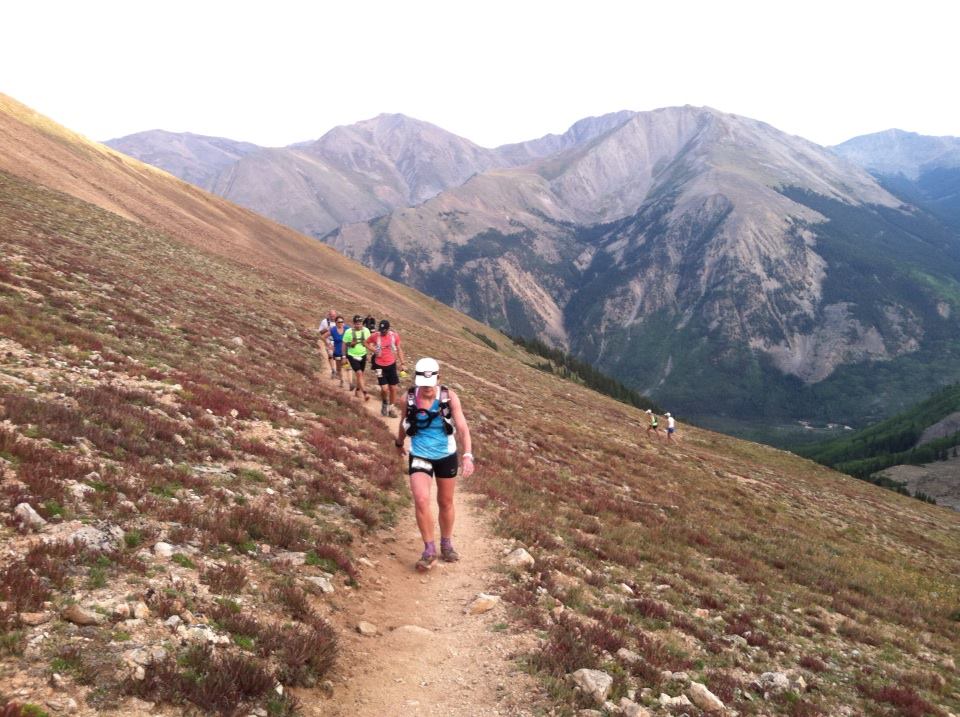
Climbing Hope Pass

Climbing Hope Pass

Finally, at 4:52, I saw her emerge between a swarm of runners and even more vehicles making her way down the gravel road to Winfield. She was flustered from a two-way traffic jam on the trail where upward runners wouldn’t let the downhill runners through, and she was dehydrated from going the last two miles without water on a hot afternoon.

Also, for the first time ever, she was concerned about beating the cutoff.

She dug plenty deep just to get to this point, and she was only halfway done.

Sherrie and I departed Winfield at 5 p.m. sharp, exactly one hour before the firm cutoff for that aid station and with the knowledge that additional course cutoffs loomed further down the trail.

We had work to do, plain and simple. There was minimal wiggle room and no time to dwell on adversity.

CLIMBING HOPE

We wasted no time getting out of Winfield. Sherrie’s brother, Bill, brought her soup while I refilled her water, chews and gels. She was in the chair no more than four minutes before rising to her feet and heading back down the road. We hiked for the first half-mile, Sherrie consuming some much-needed calories while I watched out for vehicles that seemed intent on running us over. Once we hit the trailhead and bailed off into the woods it was time to trot. The next two miles flew by as we went up and down some rolling single-track that led to the base of the climb.

Sherrie asked me in her pre-race notes to set an aggressive pace up hope, and that’s what I tried to do. It took a little while to get a feel for how hard Sherrie could push while still keeping her heart rate in check. We worked out a good rhythm where I set a steady march for a few minutes, and when her heart rate started to ramp we’d pause for a 10-second break to breathe. We passed at least 25 runners during the 2 1/2 – mile, 2,300-foot climb to the top of Hope Pass. Some were moving at a snail’s pace; others had stopped to sit down in utter exhaustion; a few keeled over on the side of the trail throwing up.1173737_10101525246675399_1766924124_n

Sherrie dug deep. She never sat down, and she never stopped for more than the 10-second breathing breaks.

She wasn’t happy – she’d been in a dark spot since before Winfield and hadn’t shaken out of that rut – but she didn’t let it slow her down. She was strong and steady for every step.

We cleared Hope Pass and made the half-mile drop to the mountain’s aid station, arriving less than two hours after departing Winfield. We made good time on the climb, and Sherrie had pushed hard.

Sherrie needed three things from the aid station – a cup of soup, a Coke, and a refill for her hand-held water bottle. The Lifetime Fitness race management struck out royally by undersupplying the hard-working aid station volunteers. They had no soda. They had a few scoops of soup left, but no cups for it. We filled Sherrie’s hand-held half way with soup instead of water and took off down the mountain.

The next few miles went quickly. We weaved our way through the woods along a creek. We started to pick up the pace, but darkness soon fell and we slowed down to pick our footing wisely while dodging the rocks and roots. The base of Hope Pass snuck up on us, and soon we weaved through a field, splashed across three water crossings, and made our way into Twin Lakes where the crew was waiting.

The water crossings gave Sherrie a bit of a pick-me-up mentally, but she still seemed frustrated. The day had been a grueling grind, and she ran low on water again coming down Hope thanks to the soup-in-the-water bottle necessity. Her crew was about the help turn things around – at least for a while.

COMING BACK TO LIFE

Sherrie’s fine-tuned crew sprung into action at Twin Lakes, getting her warm, dry clothes, and swapping out the food and fluids in her pack. In addition, her husband, Henry, cooked up some hot quesadillas and soup – exactly what she needed to put some real food in the tank.

By 8:45 p.m. we were leaving Twin Lakes, again one hour ahead of that aid station’s cutoff. A 1,500-foot climb lurked just ahead of us on Mt. Elbert, so we once again settled into a steady upward march, pausing only to shed layers when it warmed up and to let her sip some of the Mountain Dew I carried. The hot food started working its magic by the time we’d gone the three miles to Mt. Elbert Aid Station. All she needed was a refill of the hand-held, and then we were back down the trail.

Finish line in sight

Finish line in sight

There was a noticeable mood change for the next eight miles. After pushing through hours of mental darkness where she battled heat, dehydration, hunger, and overcrowding on the trails, Sherrie sprung back to life. She was chatty. She was happy. She took a few breaks to stop and stare at the clear, star-lit sky and enjoy the moment.

We hit some nice downhill sections and rolling hills and settled into a steady trot. The hour cushion we had on the cutoff rapidly grew. Soon we’d added nearly an extra hour to it.

She’d weathered hours of mental lows, dug deep and pushed through it, and finally enjoyed some happy miles in the mountains. It was inspiring to see. I’d spent hours focused on keeping us marching forward, eyeballing the clock and the cutoffs while telling Sherrie not to even think about it. She’d pushed so hard that every time she asked about the time I was able to tell her we’d added to our cutoff cushion. When we arrived at Half Pipe Aid Station around mile 71 I informed her that we’d made it there ahead of the cutoff for the previous aid station, Mt. Elbert.

LIFETIME LETDOWN

The good vibes deteriorated again at the aid station, however. Despite making good time, another undersupplied aid station threw another boulder onto Sherrie’s trail to the finish line. She needed one GU pack for the final stretch from Half Pipe to Outward Bound – GU gel packs are the very first item listed in the race Athlete Guide that Lifetime Fitness promised would be available at the aid stations – and sure enough there weren’t any. Much like a water refill or a cup of soup, it was one of the few items she relied on the aid station for the entire race, and it was unavailable.

Two miles later, Sherrie started to bonk. We were back in hiking mode on a jeep road, conserving her energy as much as possible to try to make it to Outward Bound. The absence of a single GU pack at Half Pipe was threatening to derail her race. Luckily, that’s when we reached an unofficial crewing station where another runner’s crew had some GU to spare. Sherrie devoured it, and we quickly resumed hiking while waiting for the calories to soak in and work their magic. After that, we utilized a run/hike mixture for the next few miles before reaching the paved road back to Outward Bound. Sherrie needed more calories – more real food, in particular. I texted ahead to Henry to have hot soup and quesadillas ready for her; we could see the glow of the aid station in the distance.

Finished!

Finished!

Toe trauma made running on the pavement extra painful, so Sherrie requested that we hike the road, so we marched side-by-side the final 2 1/2 miles to Outward Bound at between a 15- and 16-minute mile pace. Outward Bound had an eerie haze to it. Hundreds of vehicles – as well as runners’ footsteps – kicked up a dirt tornado that engulfed the aid station.

I could taste the filth in the air from nearly a half-mile away. My eyes had been burning for the previous 15 miles due to dirt in my eyes from the roads and the trail, but the final stretch into Outward Bound rivaled Winfield as the worst in that regard. Vehicle after vehicle veered in front of runners passing in and out of the aid station, kicked up dirt on them, and blinded them with headlights. I may have complained about it a tiny bit, but Sherrie didn’t say a word.

She just kept marching forward, digging deeper.

Finally, her son Zach emerged through the dirt cloud and guided us through the aid station circus to the spot the crew had set up. They had a chair and warm blankets ready, as well as the hot soup and quesadillas Sherrie had requested.

Her crew again brought its ‘A’ game, pumping her up with hot food and fresh energy. My pacing shift was done, and I handed her off to Larry Long for the final 23.5 miles.

Mentally, Sherrie seemed to be in a much better place than when we’d joined forces at Winfield. She hurt much more now, but she was almost two hours ahead of the cutoff, she had less than a marathon to go, and she was in Larry’s expert pacing hands.

She was going to finish. Sure, it was going to be a long, painful final 23.5 miles, but she was going to finish.

DIGGING FOR THE FINISH

There’s a ton that I didn’t see during the final stretch. Sherrie looked incredibly happy and upbeat when we saw her at May Queen Aid Station with 13.5 miles to go. She and Larry had a good 10-mile run/hike to that point. They had banked additional time against the cutoff and now had a cushion of more than 2 1/2 hours. That cushion came in handy when her legs didn’t want to run for the final seven miles. Larry tried the mental games of “let’s run to this marker” or “let’s run for 30 seconds” to no avail. It was death-march time – but not quitting time.

Sherrie and Larry hiked and hiked and hiked, and right about 8:30 a.m. they crested the final hill that brought the finish line into view.

Sherrie and pacers, post-race

Sherrie and pacers, post-race

Although we were nearly a mile away at the finish line, it was clear how much she was hurting. The pain was visible in her stride, and her head was tilted down to the ground focusing on putting one foot in front of the other. She looked up when they reached the base of the hill and began climbing toward the finish line.

She started running about 100 yards out, came down the red carpet and crossed the finish line in 28:49:15.

She’d finished her third 100-miler, and this one didn’t include the jubilant celebrations of the first two. Instead, she was just glad to be done – and I was happy for her. I knew Sherrie was tough. She’s the Wonder Woman of our running group in many respects with her feats of endurance, speed, preparation and discipline, as well as her humility. She’d never been tested like this, though. The obstacles were relentless, the mental challenges constant and far greater than the rugged terrain. She dug deep through it all, and when things got worse she simply dug deeper.

I couldn’t be more proud of my friend for her effort, and I couldn’t be more grateful for the opportunity to share part of the journey with her as a pacer.

Sherrie took Cole Chlouber’s words to heart. She stared down every obstacle imaginable, and she proved that the only way to get to overcome pain and conquer mountains is to dig deep and keep going.

ONE WEEK TO WHISTLER: NERVOUS AND READY

Posted by Chris Wristen on August 25, 2013
Posted in: Uncategorized. Leave a comment

The hard work is done. The hay is in the barn.

It’s time to travel; time to wait.

Last weekend’s big mileage, big vertical and big time-on-feet day pacing at Leadville gave way to a taper week of doing next to nothing. Work was a daily fire drill, and it left me with barely any time to run. I managed 5 miles on Wednesday evening and another 4 1/2 on Thursday evening and felt great for both. I also ran 5 1/2 of a planned 10-mile Saturday run before calling it quits due to some extreme humidity, realizing that forcing myself through the remaining miles would only hurt my chances of having a good day next Sunday at the Meet Your Maker 50-miler in Whistler, B.C.

So that’s it; the work’s done.

A few more loads of laundry, some packing, a haircut, and three nights of sleep in my own bed are all that stands between me and arrival in Whistler on Wednesday. Then I’ll get a few nervous days relaxing in the mountains – likely staring up at menacing Blackcomb Mountain and wondering how exactly we’ll climb it along with an additional 8,000+ feet of vertical. There will be the usual pre-race mind games, but I’ll draw confidence from my training, from previous races like the Pikes Peak Ascent in 2011 and the Leadville Silver Rush 50 in 2012, and I’ll constantly remind myself of the strength and determination I saw Sherrie tap into for nearly 29 hours on the trail last weekend at Leadville – and I WILL finish.

It’s going to be an incredible adventure. I get to share the trail with the top men’s and women’s mountain runners on the planet – Kilian Jornet and Emelie Forsberg. I get to share the trail with friends from Vancouver, Boston, and Austin, Texas. I get to travel beyond U.S. borders for the first time since the Kilimanjaro adventure of 2010, and I get to play in the mountains.

The hard work is done. It’s time to go play!

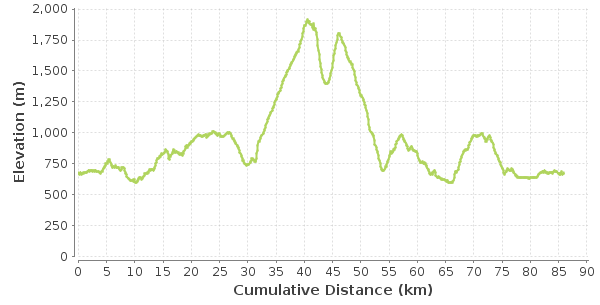
Course elevation, in meters, for the Meet Your Maker 50-mile trail race in Whistler, B.C.

Course elevation, in meters, for the Meet Your Maker 50-mile trail race in Whistler, B.C.

TWO WEEKS TO WHISTLER: LEADVILLE, HOPE PASS AND TAPER TIME

Posted by Chris Wristen on August 19, 2013
Posted in: Uncategorized. Leave a comment

Taper for the Meet Your Maker 50 unofficially began two weeks ago when I followed up back-to-back weeks of 50-plus-mile weeks with a week of minimal activity and extra treatment to the plantar fasciitis and heel inflammation caused by knots in my calf.

Now, taper time can officially begin. The biggest mileage and time-on-feet training day is in the books. That came Saturday night and the wee hours of Sunday morning when I spent nearly 8 ½ hours on the trail while pacing Sherrie Klover for 26.6 miles of the Leadville Trail 100.

The tales from the trail in Leadville will be saved for another entry, but the details of training for the week are as follows:

Total miles running: 30.6 miles

Longest run: 26.6 miles

Total vertical gain: 4,180 feet

The Meet Your Maker 50 is 13 days away, and I believe my legs are ready. They handled pacing just fine at Leadville. Hope Pass was a good challenge, and I reached a maximum elevation of 12,406 feet – significantly higher than I’ll climb at MYM.

This week will be an easy week with a planned 10-mile run on Saturday. Other key activities will be washing my gear from Leadville, packing it back up and preparing for next week’s departure for Whistler.

THREE WEEKS TO WHISTLER: SWEET RELIEF

Posted by Chris Wristen on August 11, 2013
Posted in: Uncategorized. Leave a comment

Dr. Wisner described the knot in my right calf as an “iron rod.”

It was the root of the pain in my right heel that I thought was plantar fasciitis, and the “iron rod” needed to be broken as soon as possible if my goals for the next few weeks were to happen.

I ran five miles on Tuesday on the River Trails in Lawrence, and by the time it was done it was excruciating to walk. Within moments of Dr. Wisner digging into that knot in my calf on Thursday and busting up the scar tissue, however, I could literally feel the heel de-pressurize a bit. I ran four miles on Friday evening and only noticed some minor discomfort in the heel because I focused on the heel every single step.

By Saturday night – barely 48 hours after Dr. Wisner attacked the “iron rod” – I ran 12 completely pain-free miles with friends at Coleen’s Sweaty Ass Run at the Prairie Center in Olathe. Chatting all the way, I didn’t focus on the heel while running, and the heel did nothing to try to recapture my attention.

What a relief!

The heel is happy again, and my legs feel fresher than they have in months thanks to the extra rest they’ve had this week. Now, just one test stands between them and race day at the Meet Your Maker 50 – pacing at the Leadville 100.

My legs are ready to go with Sherrie Klover for about 25 miles – including over Hope Pass – before handing her over to pacer extraordinaire Larry Long who will take her the home stretch.

After that, it’ll be two weeks of tapering until race day in Whistler.

Outside of pacing and keeping my legs moving for a few more weeks, the most critical items for me to take care of are continuing to manage my nutrition and continuing to aggressively attack my calves with the roller to make sure the “iron rod” does not return.  If I take care of those, then I should be ready to take on Blackcomb Mountain and the other 12,200 feet of vertical at the MYM50 three weeks from today.

This week’s totals:

Total running miles: 21 miles

Total cycling miles: 21.5

Posts navigation

← Older Entries
Newer Entries →
  • Archives

  • Blog Stats

    • 25,044 hits
Create a free website or blog at WordPress.com.
Chris Wristen
Blog at WordPress.com.
Privacy & Cookies: This site uses cookies. By continuing to use this website, you agree to their use.
To find out more, including how to control cookies, see here: Cookie Policy
  • Subscribe Subscribed
    • Chris Wristen
    • Already have a WordPress.com account? Log in now.
    • Chris Wristen
    • Subscribe Subscribed
    • Sign up
    • Log in
    • Report this content
    • View site in Reader
    • Manage subscriptions
    • Collapse this bar
 

Loading Comments...